


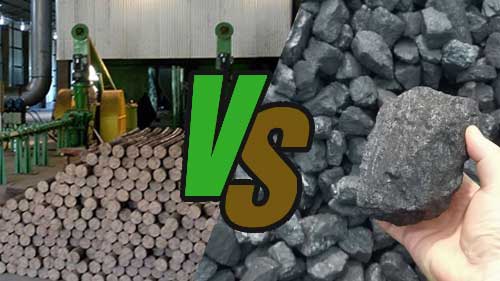
20 Jun Biomass Briquettes vs Coal: Which Fuel is Better for Industries in India?
Looking for a cleaner, cost-effective alternative to coal for your industrial operations in India?
Biomass briquettes vs coal has become a major point of comparison for industries aiming to reduce emissions without compromising on performance. In this blog, we break down which fuel is better — based on cost, efficiency, and environmental impact — to help you make an informed choice.
India’s rapid industrialization has driven a massive demand for energy sources, with coal remaining a traditional favorite for decades. However, the need for sustainable energy alternatives has never been more pressing. As industries look for eco-conscious options without compromising on efficiency, biomass briquettes are emerging as a viable solution. This blog explores the comparison between biomass briquettes and coal, focusing on their economic, environmental, and operational aspects for industrial use in India.
What Are Biomass Briquettes?
Biomass briquettes are compressed blocks made from organic materials such as sawdust, mustard husk, agricultural residue, and groundnut shells. Unlike fossil fuels, these briquettes are renewable, carbon-neutral, and cost-effective.
These are primarily used in boilers, kilns, furnaces, and heating systems across various sectors like cement, textiles, food processing, and pharmaceuticals. Their increasing use positions them as the best coal replacement in industrial boilers.
Understanding Coal as a Fuel Source
Coal has long been the backbone of India’s industrial power. It’s easy to source, has high calorific value, and a strong distribution network. However, it comes with environmental baggage:
- High carbon dioxide emissions
- Air pollution (sulphur dioxide, nitrogen oxides, PM2.5)
- Dependence on non-renewable mining
With rising international pressure and domestic environmental regulations, industries are now exploring alternative fuels for industries in India.
Head-to-Head Comparison: Biomass Briquettes vs Coal
Feature |
Biomass Briquettes |
Coal |
| Source |
|
|
| Calorific Value |
|
|
| Ash Content |
|
|
| Moisture |
|
|
| Carbon Emissions |
|
|
| Operational Handling |
|
|
| Cost |
|
|
| Environmental Impact |
|
|
Why Are Industries Shifting to Biomass?
Let’s break down the biomass fuel benefits that are driving the switch:
- Eco-Friendly Industrial Fuel: Biomass briquettes emit significantly fewer greenhouse gases. This aligns with the environmental compliance norms introduced by India’s Ministry of Environment.
- Improved Boiler Efficiency: Briquettes produce uniform heat, leading to better thermal efficiency in boilers compared to inconsistent-quality coal.
- Cleaner Operation: Less ash and smoke generation leads to reduced maintenance of industrial equipment.
- Waste Utilization: Using crop residue and other waste helps reduce open burning, contributing to air quality improvements.
- Carbon Credits: Companies switching to biomass may become eligible for carbon credit benefits and improved ESG ratings.
Challenges and Misconceptions by the Industries
Despite the benefits, some industries hesitate due to perceived downsides:
- Misconception: Briquettes are less powerful.
- Reality: Modern biomass processing delivers calorific values comparable to coal.
- Misconception: Difficult availability.
- Reality: Suppliers like Qualitybio provide consistent supply chains with storage and logistics support.
- Misconception: High initial investment in boiler adaptation.
- Reality: In most cases, briquettes can be used in existing coal-fired systems with minor modifications.
Case in Point: Cement and Textile Industries
Industries like cement manufacturing have significantly benefited from switching to biomass fuel. These sectors need high-temperature heating, and briquettes can meet these demands efficiently.
Moreover, textile factories in northern India have adopted biomass pellets and briquettes to reduce operational costs and improve sustainability metrics.
Government Push and Policy Support
The Indian government has launched several initiatives to promote the use of eco-friendly industrial fuel:
- SATAT (Sustainable Alternative Towards Affordable Transportation)
- Viability gap funding for biomass projects
- State-level incentives in Punjab, Haryana, and Maharashtra
These policies make the transition not just environmentally responsible but financially viable as well.
Final Verdict: Which Fuel Wins?
While coal remains a familiar player in India’s energy landscape, the scale is tipping toward biomass briquettes — thanks to their sustainability, lower emissions, and cost-effectiveness.
For industries aiming to future-proof operations, reduce emissions, and cut costs, the answer to “Biomass Briquettes vs Coal” is increasingly leaning in favor of biomass.
The future belongs to cleaner fuel, and biomass briquettes are leading the way in India’s industrial revolution.
To read more blog visit our blogs and To know more about QualityBio visit our Youtube Channel.
No Comments