


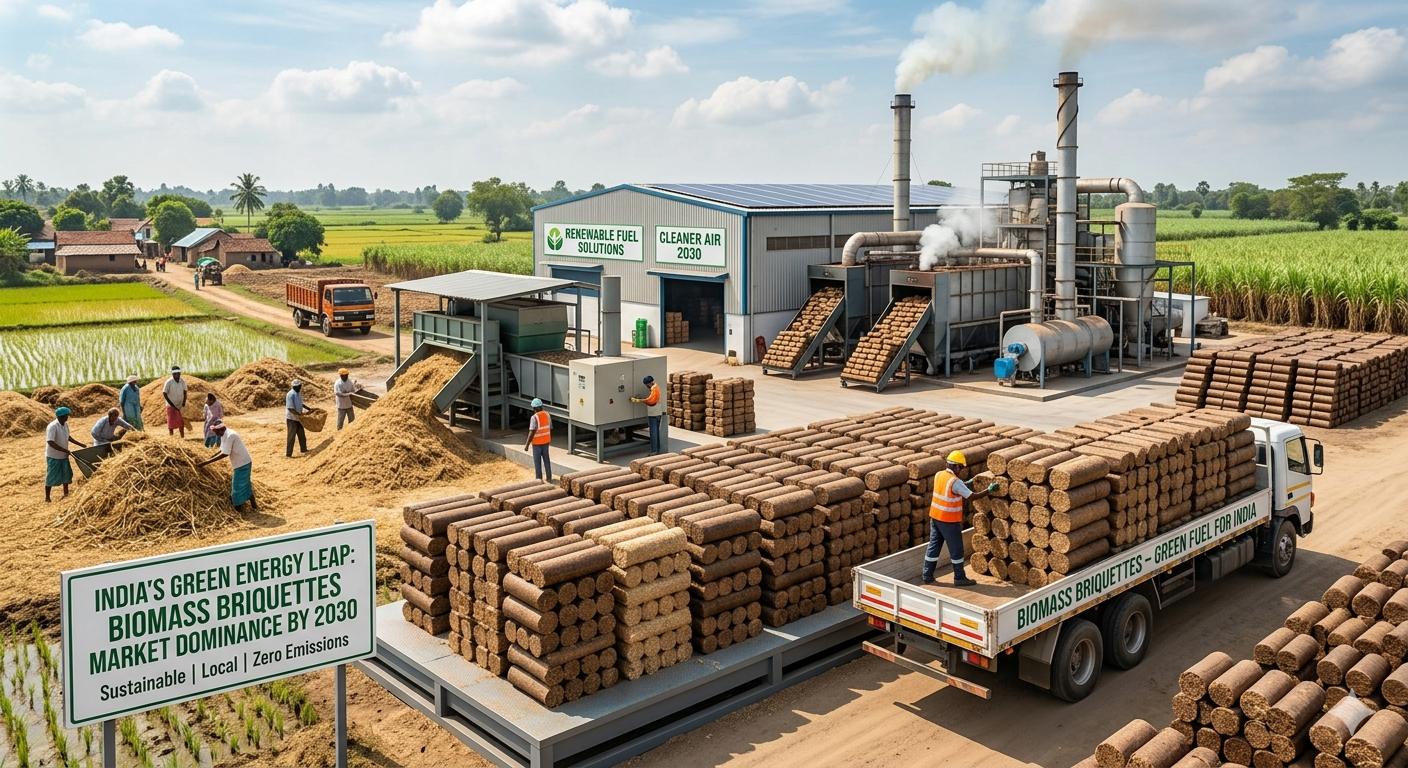
05 May Why Every Biomass Briquettes Manufacturer in India Is Betting Big on the Green Fuel Market by 2030
There is a quiet but powerful shift happening in India’s energy sector — one that does not make front-page headlines but is steadily rewriting how factories, boilers, kilns, and industrial units think about fuel. At the centre of this shift is something that might surprise you: agricultural and industrial waste, compressed into small, dense blocks of energy known as biomass briquettes. For those who have been watching this space closely, especially as a biomass briquettes manufacturer in India, this is not a surprise. It is the culmination of years of advocacy, investment, and growing awareness around cleaner, cost-effective industrial fuel.
India sits at a unique crossroads. On one side, the country is grappling with rising energy costs, carbon emission targets, and a mounting pressure from global buyers to adopt greener supply chains. On the other side, India produces an enormous amount of agricultural residue every year — rice husk, sugarcane bagasse, groundnut shells, cotton stalks, and more — much of which is either burned openly or wasted. Biomass briquettes are the bridge between these two realities, and India’s role as a dominant player in the green fuel market by 2030 is not just a possibility. It is a trajectory that the data, policy landscape, and ground-level demand are all pointing towards.
Biomass Briquettes in India: A Industry Built on Substance, Not Just Promise
Unlike many green energy solutions that require massive infrastructure overhauls, the biomass briquettes industry in India grew organically from what already existed — agricultural surplus, rural labour, and industrial demand for affordable fuel. The earliest briquette manufacturers in India were largely small-scale operations running on screw-press or piston-press technology. What has changed dramatically over the last decade is the scale, the technology, and critically, the buyer profile.
Today, the buyers of biomass briquettes are not cottage industries or small dhabas running community kitchens. The buyers are textile mills in Surat, paper mills in Andhra Pradesh, ceramic units in Morbi, brick kilns across Rajasthan and Uttar Pradesh, and even pharmaceutical companies that need consistent, regulated heat for their processes. This shift in buyer sophistication has pushed manufacturers to upgrade — in raw material consistency, moisture control, calorific value standards, and packaging for bulk dispatch. At Quality Bio, this evolution has been both a challenge and an opportunity that we have embraced at every step.
Why 2030 Is the Real Inflection Point for India’s Green Fuel Market
India has committed to achieving net-zero carbon emissions by 2070, but the intermediate targets — particularly the 2030 goals under the Paris Agreement and India’s updated Nationally Determined Contributions (NDCs) — are creating immediate, practical pressure on industries to reduce their carbon footprints right now. For industries that rely on coal or furnace oil for heat generation, biomass briquettes offer a drop-in alternative that does not require them to replace their existing boiler infrastructure. That is an enormous commercial advantage, and it is one reason why biomass briquettes services in India are scaling at a pace that few analysts predicted even five years ago.
Beyond policy, the economics have shifted decisively. Coal prices remain volatile and susceptible to import disruptions. In contrast, biomass raw material — paddy straw, sawdust, mustard stalks — is locally sourced, relatively stable in price, and available in abundance. For a procurement manager calculating total cost of energy per unit of heat generated, the numbers increasingly favour biomass briquettes, especially when you factor in the lower ash content compared to coal and the absence of sulphur emissions that can damage industrial equipment over time.
The Ministry of New and Renewable Energy (MNRE) has also been consistently tightening norms around biomass co-firing in thermal power plants, mandating up to 5% biomass blending by certain categories of plants. This alone represents a demand surge that will require tens of thousands of additional metric tonnes of supply annually — supply that manufacturers across India are racing to build capacity to meet.
What Sets India Apart as a Global Biomass Briquettes Powerhouse
There is a reason why India is not just a domestic player but is increasingly being noticed as a competitive exporter of biomass fuel products, including by buyers in Europe who are shifting away from wood pellets towards more sustainably certified alternatives. The country’s sheer diversity of biomass feedstock is unmatched. A biomass briquettes manufacturer in India has access to at least a dozen viable raw materials depending on geography — something that manufacturers in Europe or Southeast Asia simply cannot replicate at comparable cost.
The density of India’s agricultural calendar also means that raw material is available in cycles throughout the year, allowing for consistent manufacturing and supply commitments. Combined with India’s relatively lower cost of production and a growing body of quality-certified manufacturers who meet international calorific and moisture standards, the export case for Indian biomass briquettes is compelling. Countries across the European Union, Japan, South Korea, and the Middle East are already in conversations with Indian suppliers for long-term contracts.
At Quality Bio, we have seen firsthand how international buyers evaluate Indian manufacturers differently now compared to five years ago. Where once there was scepticism about consistency, there is now curiosity and genuine commercial intent. That shift in perception is a direct outcome of the industry collectively raising its standards.
How Biomass Briquettes Services in India Are Evolving to Meet B2B Demand
The conversation around biomass briquettes can no longer be limited to the product alone. What industrial buyers are increasingly asking for is a service model — one that includes assured supply contracts, logistics coordination, quality testing documentation, and technical support for integrating biomass fuel into their existing boiler systems. This is where biomass briquettes services in India are becoming a genuine differentiator between manufacturers who are growing and those who are stagnating.
Procurement managers at medium and large industrial units are not simply looking for the cheapest briquette. They are looking for a supplier who can guarantee delivery windows, maintain consistent density and moisture levels batch after batch, and respond quickly when a production line has a question about combustion efficiency. Manufacturers who have invested in this service infrastructure — warehousing near major industrial clusters, dedicated account managers, and third-party quality certification — are the ones securing the long-term contracts that define sustainable business growth.
The rise of digital procurement in India, accelerated significantly post-pandemic, has also changed how buyers find and evaluate biomass briquette suppliers. Online presence, documented case studies, transparent pricing models, and accessible technical data sheets are no longer nice-to-haves. They are baseline expectations from buyers who are vetting suppliers across multiple states before making sourcing decisions.
The Challenges That Will Separate Serious Players from the Rest
No honest conversation about the future of India’s biomass briquettes industry can sidestep the real challenges that the sector faces. Feedstock aggregation remains a structural difficulty — collecting agricultural residue from dispersed farming communities, ensuring consistent quality, and transporting it cost-effectively to manufacturing units requires supply chain capabilities that many smaller players have not yet built. The monsoon season, which affects both raw material availability and road-based logistics, is a recurring operational challenge that only manufacturers with pre-season stockpiling strategies can navigate well.
There is also the matter of standardisation. While Bureau of Indian Standards (BIS) norms exist for biomass briquettes, enforcement and adoption are still uneven. For industrial buyers — particularly those who are procurement-led and compliance-driven — this creates uncertainty. The manufacturers who will lead the industry in 2030 are those who voluntarily adopt and document quality standards today, building a verifiable track record that procurement audits can rely on. This is a philosophy that has guided Quality Bio from the very beginning of our operations as a dedicated biomass briquettes manufacturer in India.
The Road to 2030: What the Green Fuel Landscape Actually Looks Like
Picture the Indian industrial corridor ten years from now. Boilers running on a blend of biomass and natural gas. Carbon accounting embedded into every procurement decision. Supply chains that trace raw material origin from farm to furnace. Real-time quality monitoring using sensor-based combustion analytics. This is not a vision document — this is the direction that leading manufacturers, policy institutions, and international buyers are collectively building towards.
India’s biomass briquettes industry will not dominate the green fuel market by accident. It will do so because the fundamentals are right — the raw material surplus is enormous, the demand trajectory is clear, the policy tailwinds are real, and a core group of manufacturers has been quietly building the quality, service, and trust infrastructure that this industry needs to earn its place in the global green economy. For Quality Bio, this is not just a market opportunity. It is a responsibility — to our buyers, to the farming communities whose waste we transform into value, and to the broader goal of building an industrial India that is genuinely cleaner and more self-reliant in its energy choices.
The next five years will decide which manufacturers cross over from being regional suppliers to becoming trusted national and international players. The window is open. The question is simply who is ready to meet the moment.
Frequently Asked Questions (FAQs)
1. What is the calorific value of biomass briquettes made in India, and how does it compare to coal?
The calorific value of biomass briquettes produced by Indian manufacturers typically ranges between 3,800 to 4,500 kcal/kg depending on the raw material used. Rice husk briquettes tend to fall on the lower end of this spectrum, while sawdust and cotton stalk briquettes can achieve higher values closer to 4,400 kcal/kg. In comparison, Indian non-coking coal (which is predominantly what domestic industries use) has a gross calorific value ranging from 3,500 to 4,500 kcal/kg depending on the grade. What makes biomass briquettes particularly competitive is not just the calorific value but the overall combustion profile — lower sulphur content, lower nitrogen oxide emissions, and significantly lower ash residue compared to coal. For industries operating boilers that require consistent heat input with minimal ash handling, biomass briquettes offer a technically superior and environmentally cleaner alternative at a comparable or lower landed cost.
2. Which industries in India are the largest consumers of biomass briquettes, and why?
The largest industrial consumers of biomass briquettes in India are spread across sectors that require continuous, high-volume heat generation. Brick kilns are among the highest-volume users, particularly in states like Uttar Pradesh, Bihar, Rajasthan, and Punjab, where the transition away from coal is being driven partly by NGT (National Green Tribunal) directives. Textile dyeing and processing units — concentrated in Gujarat, Rajasthan, and Tamil Nadu — use biomass briquettes extensively in their steam boilers. Ceramic tile manufacturers, particularly in the Morbi cluster of Gujarat, have made a significant shift towards briquettes as a substitute for coal and lignite. Food processing units, paper mills, chemical plants, and pharmaceutical manufacturers are also growing consumers. The common thread across all these sectors is the need for a cost-effective, reliable fuel that can be burned in existing boiler infrastructure without major capital modifications. Biomass briquettes satisfy all three of these requirements simultaneously.
3. How do I evaluate the quality of a biomass briquettes manufacturer in India before placing a bulk order?
Evaluating a biomass briquettes manufacturer before a bulk purchase involves looking at several layers of operational and product quality. Start by requesting a detailed technical data sheet that specifies calorific value, moisture content (ideally below 10%), ash content, sulphur percentage, and bulk density — these are the parameters that directly affect how the briquettes perform in your boiler. Ask whether the manufacturer conducts batch-level testing or only tests periodically. Request samples for independent laboratory testing before committing to a volume. On the operational side, assess the manufacturer’s raw material sourcing strategy — those who stockpile pre-season and have diversified feedstock sources tend to maintain more consistent quality year-round. Check whether they have experience supplying to industries similar to yours. Certifications from recognised agencies, a documented quality management process, and the ability to provide logistics support for bulk interstate dispatch are strong positive indicators of a manufacturer who is serious about long-term business relationships rather than one-time transactions.
4. Are biomass briquettes suitable for use in standard coal-fired boilers without modification?
Yes, in most cases biomass briquettes can be used in existing coal-fired boilers without requiring major structural modifications, which is one of the primary commercial advantages of this fuel. The key consideration is the grate design of the boiler — fixed grate and travelling grate boilers are generally well-suited for biomass briquettes, particularly when the briquettes have a consistent diameter and density that allows for uniform airflow and combustion. Fluidised bed boilers also accept biomass briquettes effectively. The main adjustment that operators typically make is to the air-to-fuel ratio settings, as biomass combustion requires slightly more secondary air compared to coal to achieve complete combustion. Ash handling may also need slight operational adjustments depending on the ash content of the specific briquette type being used. It is always advisable to consult with the boiler manufacturer or a certified energy auditor when transitioning from coal to biomass, particularly for high-pressure steam applications, to ensure that the transition is both efficient and safe.
5. What is the future market size and growth outlook for the biomass briquettes industry in India?
The biomass briquettes and pellets market in India is on a strong upward trajectory, driven by a convergence of policy mandates, rising coal prices, increasing corporate sustainability commitments, and growing export demand. Industry estimates suggest that the biomass energy sector in India — of which briquettes form a significant portion — could grow at a compounded annual rate of 8 to 12 percent through the end of this decade. The MNRE’s push for biomass co-firing in thermal power plants alone is expected to create significant additional demand running into millions of metric tonnes annually. On the export front, European Union Renewable Energy Directive requirements are creating sustained demand from EU-based industrial buyers for certified biomass fuel, and Indian manufacturers who can meet traceability and sustainability certification requirements stand to capture a meaningful share of this market. By 2030, the domestic industrial biomass fuel market in India is expected to be substantially larger than it is today, with biomass briquettes playing a central role alongside pellets and torrefied biomass products.
No Comments